Runways
Your runway decides which aircraft can visit. A mown grass strip is enough for light aircraft; turboprops and jets need asphalt, and the big ones need a lot of it.
Grass strips
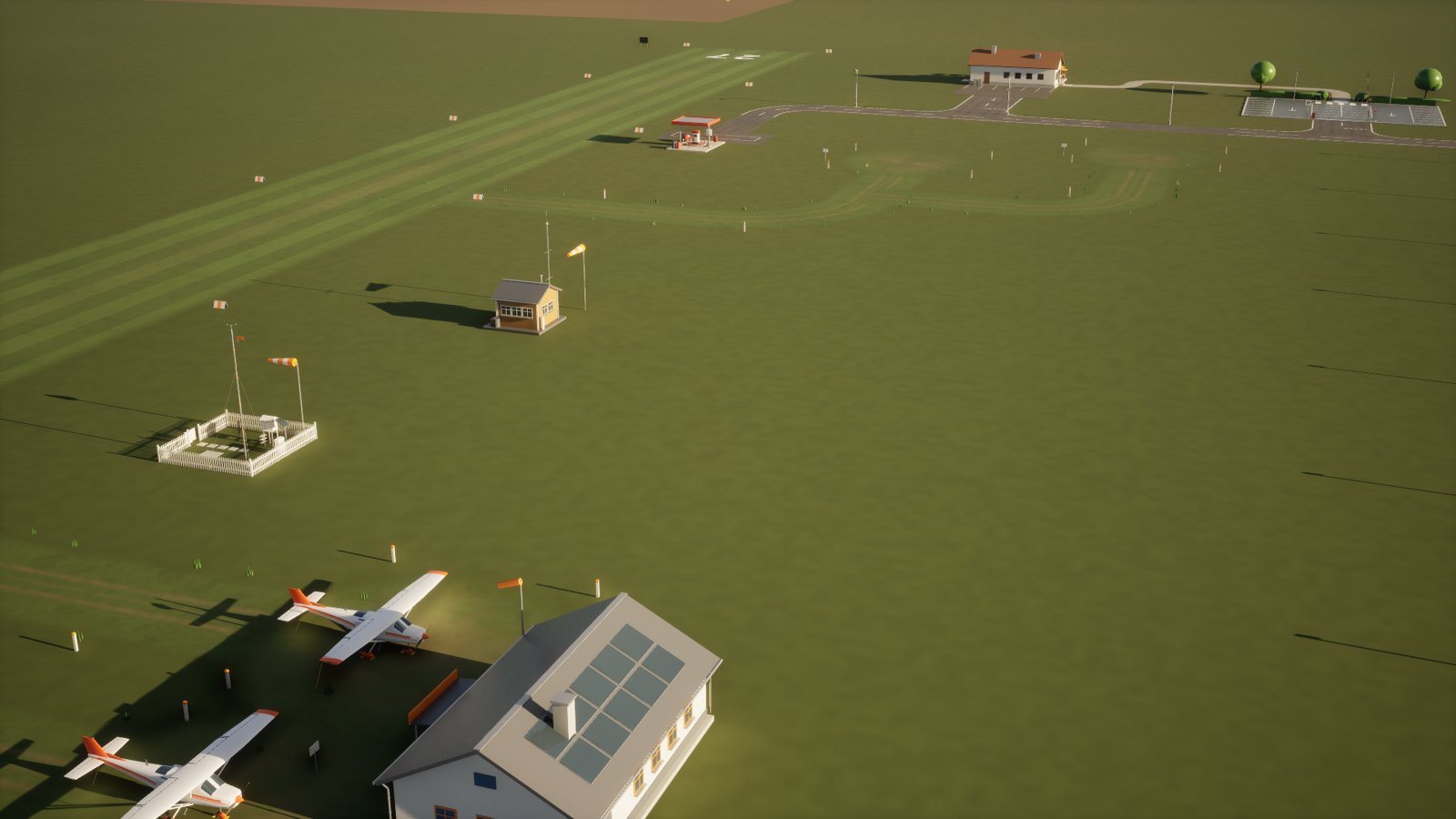
Every career starts on grass. A strip is cheap (mowing and staking out, about 6 € per m²) and quick to build. Grass has two limits:
- Weight: at most 5.7 t take-off weight on grass runways, taxiways and stands. The Sparrow S4 and Plover P6 are fine; the Kestrel K19 is not.
- Rain: a grass strip closes when it rains and stays shut for about three hours while it dries. The research Drainage cuts that to one hour.
Pilots also break off more approaches on unmarked grass. The research Landing aids puts marker boards along the strip and makes aborted approaches much rarer.
Asphalt
The research Asphalt runway (45 research points) brings paved runways up to 1,200 m for heavier aircraft. Asphalt costs about 16 € per m² plus a small daily maintenance per m², stays open in rain and is the requirement for the terminal, the control tower and almost everything in phase 2. Long runways later allows up to 2,500 m and extending existing runways; Concrete pavement in phase 4 costs more and takes longer to build, but needs far less maintenance.
Which aircraft need what
| Aircraft | Category | Surface | Runway from |
|---|---|---|---|
| Sparrow S4 | A | Grass | short strip |
| Plover P6 | A | Grass | about 440 m |
| Kestrel K19 | B | Paved | about 720 m |
| Swift S9 | B | Paved | about 950 m |
| Tern T48 | C | Paved | about 1,070 m |
| Heron H80 | C | Paved | about 1,350 m |
| Gannet G170 | D | Paved | about 1,700 m |
| Albatros W290 | E | Paved | about 2,250 m |
How many runways?
You may build more runways than you can use: the tower level decides how many are in operation at the same time – one with the radio hut and control tower, two with radar, four with the large tower.